
 The Cape Society
-
 1764
In the beginning...
1764
In the beginning... -
The first history dates from 1764 when members were dubbed “Knights of the Cape” although how the word "Cape" came to be applied is not known with any certainty. There is an opinion, which might readily be accepted, that at that time when a curfew was operating, late revellers approaching one of the City Ports (or gates) at which stood a guard, devised a ruse to distract his attention while they slipped through unobserved. This was known as "doubling the Cape".
-
1766
Feasting...
-
Two Grand Feasts i.e. Grand Capes or Grand Festivals were held each year, the one in October 1766 being called a "Turtle Feast". Here, also, we have no knowledge about the origin of this name. It is conjectured that our original Knights enjoyed a Turtle dish during the meal and the name became associated with this particular function thereafter.
-
1768
Watchwords...
-
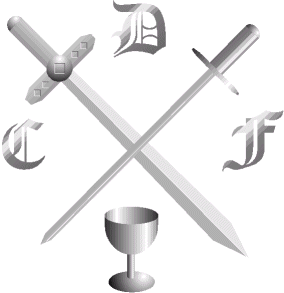
In the year 1768 the first regular officers were appointed and our Grand Seal bearing the watchwords CONCORDIA, FRATRUM, DECUS was granted by the Lord Lyon King of Arms.
-
1769
Tom Lancashire...
-
The first recorded Sovereign was Tom Lancashire, a Comedian of local renown, and in 1769 he and some other Knights laid the first stone of the new Comedy Hut belonging to Sir Cape.
-
1770
James Thomson...
-
At ten yearly intervals from 1770 the Society celebrated the birth of James Thomson who was born at Ednam although the reason for such a commemoration is not known.
-
1778
Edinburgh Volunteers...
-
ln the year 1778 the Society subscribed 100 guineas towards the formation of the Edinburgh Volunteers thus showing our allegiance to our city and country.
-
1793
65th Anniversary...
-
An advertisement appeared in the ‘Herald’ of 1793 announcing that the 65th Anniversary would be commemorated on 5th March of that year. This date would appear to place the founding of our Society firmly as the year 1728.
-
1800
Cape Abounds...
-
On Monday 15th September 1800 the Edinburgh Evening Courant published this paragraph:
We are informed that this year, upon Monday 22nd September, being a complete century from the birth of the Scottish Bard, James Thomson, who was born in 1700, on the day of the Autumnal Equinox, the Knight Companions of the Cape are again to hold their jubilee festival in Celebration there-of by Recitation, Vocal Music, etc. under the direction of Mr. Woods of the Theatre Royal, who has conducted the like entertainment repeated by them in their Hall on that day, every tenth year since 1770.
Our places of meeting were varied and premises occupied included the ‘lsle of Man Tavern‘ at Craigs Close, the ‘Kings Head’ in Bridge Street, Leith, Canal Street and finally the ‘Railway Tavern’ at 3a Hope Street. Our members included Gavin Wilson, James Watt, Henry Raeburn, Robert Fergusson and William Brodie. Other Cape Halls flourished in Glasgow, Manchester, London and Charlestown, South Carolina. At the height of its power the Cape Society had 600 members on its roll. -
 1841
Sadder Times...
1841
Sadder Times... -
Eventually in 1841 the Cape disbanded, its funds being handed over to the Royal Infirmary, Edinburgh, and the Pokers and Sovereign’s Hat lent to the Society of Antiquarians of Scotland, Queen Street, Edinburgh, where these could once be seen. They were relocated to the newly built Museum of Scotland which opened on 30 Nov 1998. The Museum of Scotland merged with the Royal Museum next door in 2006 to create the National Museum of Scotland.
-
 1965
Gladder Times...
1965
Gladder Times... -
In May 1965 the Society was brought to life again by much research and the perseverance of James Grubb. The first meeting was held on 11th May at 6 Summerhall Square when seven founder members were in attendance and the title of Grand Sovereign was bestowed on him. The second assembly on 2nd June was held in the new Cape Hall, the "Lothian Bar", Lothian Road which was occupied until 4th December 1968 (and at that time our numbers had risen to 49) when we moved into new premises at the "Royal Mile Bar", High Street. Then in November 1969 as the building was momentarily unsafe we required to seek new accommodation and on 3rd December 1969 we moved into the "Regal Arms", 58 Morrison Street.
-
1700s
Tidbits...
-
Of further interest to you may be a few of the early rules which applied in those far off days.
1. Usual hours to be about 7 to 8 in the evening but never later than 1 a.m.
2. Neither gaming nor smoking tobacco shall be allowed in the Cape, but smoking tobacco allowed with wine.
3. No bet or wager to be taken in the Club unless the amount is immediately tabled and drunk at the same meeting.
4. One penny for the newspaper and twopence for the waiter for the reckoning.
5. Carrying off a newspaper to be fined 1 Green Stoup i.e. 1/4d Scots.
What follows is a more comprehensive history of the Cape Club and reconstituted Cape Society; up to 1991. It was discovered early in 2025 by Sir Kirkwall on a CD long hidden in his house which he’d been given by Sir Prestonpans many years previously. It’s thought this more comprehensive history is the work of Sirs Prestonpans and North Leith and is also evidence of the odd reference to ‘updated history’ which some Knights recall being referred to by, in particular, North Leith, back in the 1990s.
The true history of our society is somewhat obscure but certain items from the past have emerged which throw some light on our activities over the centuries.
The first history date from 1764 as recorded in the sedurunt books, now in the keeping of the National Library of Scotland, these books having been transferred there from the Museum of Antiquities in Queen Street to which all our regalia and belongings were donated in 1841 when the original Cape disbanded.
How the name Cape came to be applied is not known with any certainty but one opinion is that when a curfew operated on the gates of the walled city in these days, late night revellers approaching one of the Ports devised a ruse to distract the guards’ attention while they slipped through unobserved. This was known as ‘Doubling the Cape’. Mariners also used this expression when rounding Cape Horn as they found the easiest way to sail from Atlantic to Pacific in heavy storms was in a zig-zag movement. A large canvas portraying this manoeuvre entitled Rounding the Cape can be seen hanging in Trinity House, Leith.
Various fraternities met daily in the taverns situated in the closes off the High Street in the Old Town and that many formed themselves into clubs or societies. The literary Clubs and Societies of Eighteenth Century Scotland, Vol 2 by D. D. McElroy renders a more academic picture of the period.
1Other clubs existing at that time were the Beggars Bennison, the Boar Club, the Chrochallan Fencibles, the Easy Club, The Feast of Tabernacles, Gowks, the Griskin Club, the Hellfire Club, the Horn Order, The Industrious Company, The Mountain Club, the New Club, the Oyster Club, the Poker Club, the Rifgt and Wrong Club, the Ruffian Club, Saint Cecilia Catch Club, the Soaping Club, the Sonss of Solomon, the Spendthrift Club, the Sunday Club, the Tuesday Club, the Whinbush Club, the Wig Club and the Worthy Club.
Our first sovereign appointed in 1764 was James Aitken, dubbed Sir Poker, He carried the office for two years to be followed by Tom Lancashire, a comedian of local renown in whose dwelling the Cape seems to have been born. Tom chaired the first Grand Cape on 23rd October 1766 at Alexander Dick’s in Foulis Close, the for which was £5. 10/-
On the death of Tom (Sir Cape), Robert Fergusson (Sir Precentor) wrote :-
Alas, poor Tom! How oft, with heavy heart, Have we beheld thee play the Sexton’s part. Each comic heart must now be grieved to see The Sexton’s dreary part perform’d on thee.
By the time of the second Grand Cape on 28th June 1768 our name had changed to Knight Companion of the Cape. In that same year on the 10th September, the third Grand Cape was held in Walker’s in Leith, the bill this time being £5. 7/8d. On 17th November 1768 the Fourth Grand Cape was held and the first regular officers appointed. At this time our Grand Seal bearing the watchwords ‘Concordia -Fratrum – Decus’ was granted by the Lord Lyon King of Arms. A cape and crown were also made up of a very curious construction and every member was crowned at his admission. A letter to Cape Hall at this period mentions that there was hope of obtaining a turtle for the Grand Feast. The British fleet returning from the Galapagos Islands – where they discovered a large turtle and returned with it as a prize for the Lord Mayor of London’s Banquet where it was considered a delicacy – were held in great esteem and in their honour Turtle Feasts became fashionable within society.
At this juncture the daily meetings moved from Alex McGregor’s in Brown’s Close by the Luckenbooths to John Wood’s in Heriots Gardens. Next we moved to Mr. Drumbreck’s at the King’s Head in Bridge Street but meetings were not held there for long, for on the 29th May 1769. The cornerstone of Comedy Hut belonging to Tom Lancashire was laid at the east end of Princes Street. [Reminding ourselves of the geography of the Old Town, it is not difficult to speculate a misprint of Comedy for Comely, as certainly the maps of this period show various buildings erected in the area now known as Comely Gardens in Lower London Road, which could be classified as being positioned at the East End of Princes Street. Other speculation has it that the Comedy hut was part of the old Theatre Royal which stood at the East End on the site of the G.P.O. Other research has Tom Lancashire living at the head of the Cannongate.
Shortly thereafter on 18th August 1769 the meeting place was changed to the Crown in Kennedy’s Close. Sixth Grand Cape was held in celebration of the memory of William Shaksepeare. Twenty eight Knights attended and the bill came to £9. 14/4d. On 22 October 1769 an ordinary Cape meeting was held in celebration of the poet James Thomsen of Ednam(1740 – 1748) who wrote the words to Thomas Arne’s music of Rule Britannia which was first performed before George II in the Masque(the modern day equivalent is a musical) Alfred in 1740 in honour of Fredrick the (II) Great and the anniversary of the House of Hanover, at the beginning of the war of Austrian Succession. He (Thomson) was more noted in his own time for his poem, The Seasons, which served as an inspiration to continental musicians. (notably Vivaldi)
At the seventh Grand Cape a silver medal encrusted with precious jewels was presented by Sir Stick to be worn at meetings by the sovereign of the Cape. The 8th Grand Cape was held at John Wood’s and the 9th at Tom Lancashire’s. The 10th held on the 22nd October 1770, was again in memory of James Thomson and the 32 Knights attending were presented with a bill for £4. 1/10d. At the next Grand Cape certain rules were finalised. One rule stated that the carrying of a newspaper which was the Caledonian Mercury exacted a fine of one green stoup. Now a stoup is by some sources a drinking mug, by others its contents, i.e., a liquid measure, and yet by others a monetary value of one farthing, or one shilling and fourpence, depending on the reading of 1/4d in the old minutes, probably the price of the measure. It seems unlikely that possession of a paper would incur the displeasure of the company but perhaps the carrying away of the same would require the culprit to down a mug of green ale costing a farthing.
By the 12th Grand Cape on 13th August 1771 we had moved yet again, this time to Walter Scott’s in Geddes Close. Here we also met for the 13th Grand Cape on 25th January 1772 and the 14th Grand Cape on 5th September of that same year. The 15th Grand Cape was again held in John Wood’s and the 16th in John Swanson’s.
To put it historical perspective it must be remembered that the first North Bridge was being built around this time and many of the Old Closes were demolished previous to its construction. We remained in Walter Scott’s until 1st March 1774 and in 1778, subscribed 100 guineas to the formation of the Edinburgh Volunteers showing allegiance to City and Country. During this time the Cape paper changed from the Caledonian Mercury to the Edinburgh Advertiser. Also around this time Sir John Barry (Knight of the Ready) was elected depute Sovereign to the Glasgow Cape. The 17th was held in Wood’s Garden with the daily meetings in James Mann’s Close, the lower half of which can be entered from Cockburn Street. The 50th Grand Cape was minuted as taking place in 1790 and the 63rd Grand Cape took place in 1797. Unfortunately no venues are recorded for those occasions.
There is mention also of a dispensation being issued for a Cape Hall in Charleston, South Carolina but references to this branch of our Cape Society are slight. . An alternative entery takes us to the period circa 1781 where it would appear that differences of opinion, possibly political, left us without interim records but on 13th March 1784 is minuted a Union Festival in the Assembly Hall which is advertised as the 37th Grand Cape. Festivals or Feasts were therefore held at roughly six-month intervals, the one on 12th February 1785 being in Post Office Close The penultimate entry in the sederunt books records the 44th Grand Cape at Peter Clerk’s on the 4th October 1787. This was at a time when Robert Burns was visiting the city but his only connection with the Cape would seem to be through his admiration of Robert Fergusson who died in 1774 in Bedlam (by Bristo Port) aged 24. The tombstone of Fergusson in the Canongate Kirkyard was paid for by Burns at a cost of £5. 10/-, after two years as that was the length of time the monumentalist had taken to erect it. Burns also wrote a couplet for the headstone of another of our members the religious poet Michael Bruce (Sir Thomas) at the request of the Moderator of the Church of Scotland, George Baird.
Former members included Gavin Wilson, James Watt, Henry Raeburn, Robert Fergusson, Alex Runciman and Deacon Brodie.
From 1791 to 1802 we met in Peter Leslie’s and in 1793 an advertisement appeared in the Herald announcing a 65th Grand Cape on 5th March. Given that there were two Grand Capes per annum this would substantiate our founding circa 1761, and out last recorded minute is dated 29th March 1841.
In 1827 the Cape was effect no more a virulent society due to political machinations of the time and on that date the final inventory read as follows:
2 silver plated mugs 2 plated mugs or cups 2 tin green stoups 12 pewter porter pots 7 painted pictures 1 ballot box
The large mahogany chest, containing one book of records, the Council Book of Petitions, Crown and Sceptre, 2 pokers, Roll of Members, tin box, a barrel, a trumpet, a variety of paper cuttings, old Petitions, small Minute of Sederunt Books and other vouchers and 3 maces.
The Society went into abeyance until 1841 when it was called to order by the Worthy Sovereign to dispose of the above listed paraphernalia. A meeting was called early in that year at which a few Knights attended, thereafter an advertisement was placed in a local paper calling a General Meeting at which a quorum was in attendance thereby donating our artefacts to the Royal Society of Antiquaries and monies (unminuted amount) to the Royal Infirmary Edinburgh.
In 1965 the Society was brought to life again by much research and perseverance of James Grubb. The first reconstituted meeting was held on 11th May at 6 Summerhall Square where 7 founder members were in attendance and the title of Grand Sovereign was bestowed upon him. Thereafter further assemblies were held in the Falcon Arms and on 2nd June our occupancy was at the new Cape Hall, the Lothian Bar, Lothian Road which was our home until 4th December 1968 (and at that time our numbers had risen to 49)when we moved into new premises at the Royal Mile Bar, High Street. Then in November 1969 as the building was momentarily unsafe we required to seek new accommodation and, on 3rd December 1969 we moved to the Regal Arms, 58 Morrison Street. In 1973 the first Turtle Feast of the new society was held at Garvald. Eleven Knights attended a supper of pie and beans. Nine Knights returned the following year.
In 1975 we moved to Jim’s Inn in Cockburn Street where the proprietor James Bell was dubbed honorary Knight Sir Ballater. By this time our roll had risen to over one hundred although 20 was thought a good number attending a meeting. At the end of 1975 we moved to the Royal Overseas League, 100 Princes Street with Sir Sciennes as Worthy Sovereign and held our Turtle Feast there. The 1976 Turtle Feast was postponed by Worthy Sovereign Sir Abercorn and was celebrated in 1977 by 26 Knights. In October that year Sir Langdykes invited Sheriff Martin Mitchell to address our dinner. November 1978 saw the introduction of our chelonian centrepiece, nicknamed Herbert by its guardian and polisher, our archivist Sir Kowloon. That meeting was presided over by Worthy Sovereign Sir Bromley. The following year Sir Blackhall took the chair and to him Sir Quarryholes presented a print of the Turtle Catchers to be passed on at subsequent feasts to the reigning Sovereign. Year 1980 was Sir Guildford,s reign. His speaker at the Feast was Dr. Robert Muselfelt. In 1981 Sir Newhaven introduced the well known ‘literary outlaw’ Forbes McGregor who kindly donated copies of his latest book to Cape Hall. The next annual celebration was still at the Royal Overseas League when Sir North Leith combined the Turtle Feast with a Robert Fergusson night, concocting the turtle soup to his own recipe.
In 1983 we found the Tolbooth Tavern a haven for our monthly assembly but attendance figures dropped from an average of about thirty to about twenty, the steep climb uphill at a late hour being the main reason for absenteeism. That year Sir Tollcross organised the Turtle Feast at the Edinburgh University Staff Club in Chambers Street.
The following year the Worthy Sovereign Sir Sciennes opted for the same venue. By 1985 Worthy Sovereign Sir Fowler chose to take us back to the Royal Overseas League for out annual outing. At the Suggestion of Sir Kowloon, Worthy Sovereign Sir Newtoft in 1986 booked the Merlin at Morningside where we were well entertained by a semi-professional conjurer. From 1980 onwards catering had been for nearly 40 each year but by 1987 our numbers were declining; lack of support saw the Grand Feast cancelled and Worthy Grand Sovereign, Sir Duneidinn, took to chairing the monthly meetings. In September 1988we moved to the White Horse in the Canongate, and for the Turtle Feast, in October. With the Worthy Grand Sovereign still presiding in the chair, it was agreed to change the Turtle Feast to a Manor and to allow Lady members in order to augment numbers. About a dozen couples attended the Iona Hotel. This formula was also adopted by Worthy Sovereign Sir Orchardbrae in 1989 and again proved successful. The 1990 Turtle Feast was chaired by Sir Pilrig at the Marina Hotel followed by Sir Picardy’s Turtle Feast, Again at the Marina Hotel. Our regular monthly attendances were at this point about eight or ten members but recent candidates have rekindled with a spark the flickering flame of our society, which we trust will endure the annals of Edinburgh for many years hence.
Sadly, our founder and latter day guiding light, WGS Sir Duneidinn (James Grubb) eventually passed on in late 1991, after a brave stand against terminal illness. His legacy is our society. May we uphold its tradition and his memory.
Such then is the history of our Cape. Let us now go forward with respect for the old Society and a willingness to further the interests of the new.
Old Cape Toast Now God in Heaven Bless Reekies Town Wi’ plenty joy and peace And may her wealth and fair renown To latest times increase. Old Cape Toast
Of further interest to you will be the early rules which applied in those far off days.
Sir ……. Will acquaint you of them.
1. Usual hours to be about 7 to 8 in the evening but never later than 1a.m. 2. Neither gaming nor smoking tobacco shall be allowed in the Cape, but smoking tobacco allowed with wine. 3. No bet or wager to be taken in the Club unless the amount is immediately tabled and drunk at the same meeting. 4. One penny for the newspaper and twopence for the waiter for the reckoning. 5. Carrying off of a newspaper to be fined 1 green stoup. i.e. ¼d Scots.